



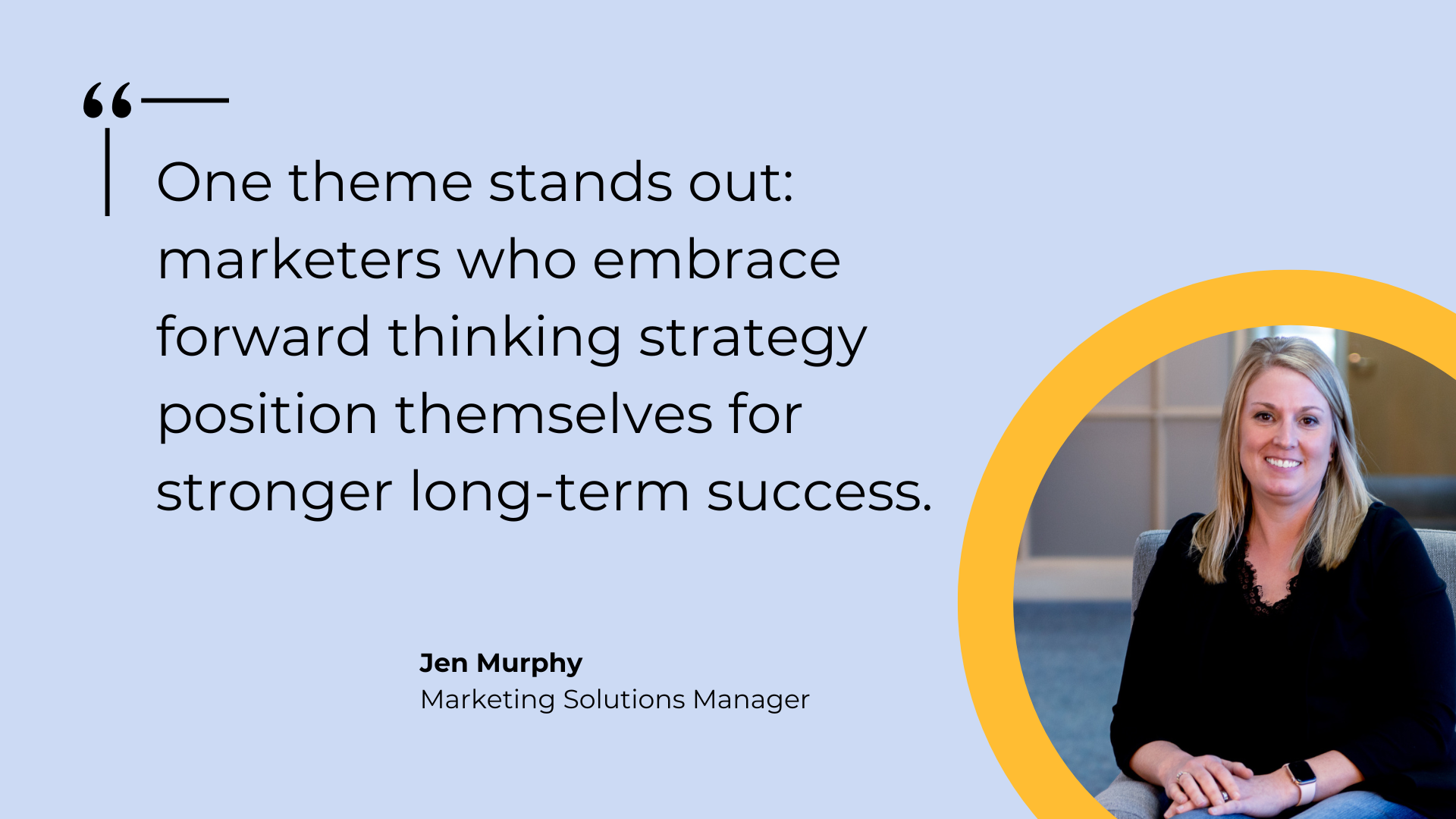
The first conversations with a client are often the most insightful. Marketers come to these conversations with a range of goals: learning more about direct mail, exploring ways to strengthen their program or uncovering how our capabilities could enhance what they’re already doing. Performance improvement is one possibility — but not the only one.
It takes a team effort in those early discussions. Our Marketing Solutions Specialist, Jen Murphy, spends much of her time working to understand intricate programs and recommend the right solutions for prospective clients. Over time, she’s recognized patterns and trends in the areas where marketers most often struggle with their direct mail strategy.
We asked her a few questions about these pain points to share guidance with marketers looking to strengthen their planning and build more effective programs.
Forward Thinking is the Foundation of Direct Mail Strategy
According to Jen, one of the key opportunities for marketers is starting with a long-term outlook for their direct marketing strategy. Jen stresses that marketers benefit most when they map out how initial tests connect to future decisions — how they will adjust if performance is strong, how they will respond if results fall short and how each phase builds toward a more sustainable, scalable program.
This proactive agile mindset is essential because campaigns rarely go exactly as expected. Jen explains: “You need to ask: if this campaign delivers on our goals, what’s our next step? If it fails, what will we learn and improve from it?”
Forward thinking is a core principle that helps direct mail programs stay resilient and adaptable in a fast-moving market.
Data Strategy: Setting the Foundation for Smarter Targeting
Data is the backbone of any campaign, yet marketers often face the challenge of navigating audience selection with confidence. Targeting and segmentation can be incredibly nuanced, and choosing the right approach influences not only who you reach, but how effectively your message drives results.
Jen sees this challenge in her conversations with prospects.
“Some marketers have their segmentation dialed in and know exactly who their best customers are. Others only have broad demographic buckets to work from,” she explains.
She emphasizes that the real opportunity is helping marketers understand their audience in a way that supports long-term performance.
“Wherever a team is starting, we are thinking through different ways to identify top responding tiers, explore additional data sources when needed, or even pull segments together to gain scale while still keeping personalization intact.”
This collaborative approach ensures marketers can make informed decisions that directly support their goals.
Creative Testing: Building Insights That Shape Future Performance
Creative testing plays a critical role in helping marketers understand which messages and formats truly resonate, yet many teams struggle to approach it with structure and consistency.
Jen sees a wide spectrum of testing maturity in her conversations with prospects.
“We have some prospects who actively test every campaign and measure those results. They can go back in their portfolio for years and see what tests they’ve run and how they performed,” she explains.
This level of discipline allows marketers to understand what’s working — and why — and to build on those learnings over time.
But not every team arrives with that level of rigor.
As Jen notes, “Other marketers say things like, ‘We tried that format and it failed’ but when we dig deeper, they might be basing that view on perception not data.
She points out that without defined metrics, the results can be misleading because performance can be influenced by timing, external conditions or other variables marketers may not be accounting for.
Helping marketers design a testing program that controls these variables through strategies like holdout cells and back testing is where strategic creative testing becomes most impactful.
This approach empowers marketers to shift from instinct-driven decision-making to repeatable, data-supported insights that fuel future performance.
Building Trust and Acting as an Extension of the Client Team
Trust is foundational in any marketing partnership, and Jen often sees how meaningful it is when marketers understand they have true support behind them. She describes how marketers respond when they see the level of care, attention and expertise that our team at Nahan consistently applies.
“An aha moment comes when they see how a full-service direct mail partner will consider all aspects of a campaign from strategy to execution, and how streamlined the process can be,” she notes.
Jen emphasizes that thoughtful guidance based on direct response best practices is central to our approach, noting that marketers appreciate when decisions are grounded in what will genuinely move their program forward, both in terms of driving improved campaign performance as well as operational efficiencies.
She explains that the goal is always to provide strategic direction aligned with the marketer’s objectives and the realities of their audience, timeline, budget and measurement framework. This clarity helps teams feel confident that they’re making informed choices suited to their specific situation.
Ultimately, Jen describes the consultative partnership that we can offer in terms that resonate with many marketers she speaks to.
“We’re an extension of your team. We are only as successful as you are,” she says.
Wrapping Up
Jen’s conversations with marketers illuminate that the strongest programs are built by teams who think ahead while remaining agile — whether that means adjusting when a data source underperforms, refining creative based on results or preparing for market changes that are likely to influence response. Staying ahead of these variables gives marketers the clarity and control needed to build momentum over time.
As Jen says, “Always be thinking ahead: how will what we are doing today be a building block for the future?”
A forward-looking mindset empowers marketers to make confident decisions, adapt quickly and build campaigns that continue to evolve rather than stall. It sets the tone for continuous improvement and ensures that every component of the program — strategy, execution, and optimization — moves with intention and purpose.